Clockwork
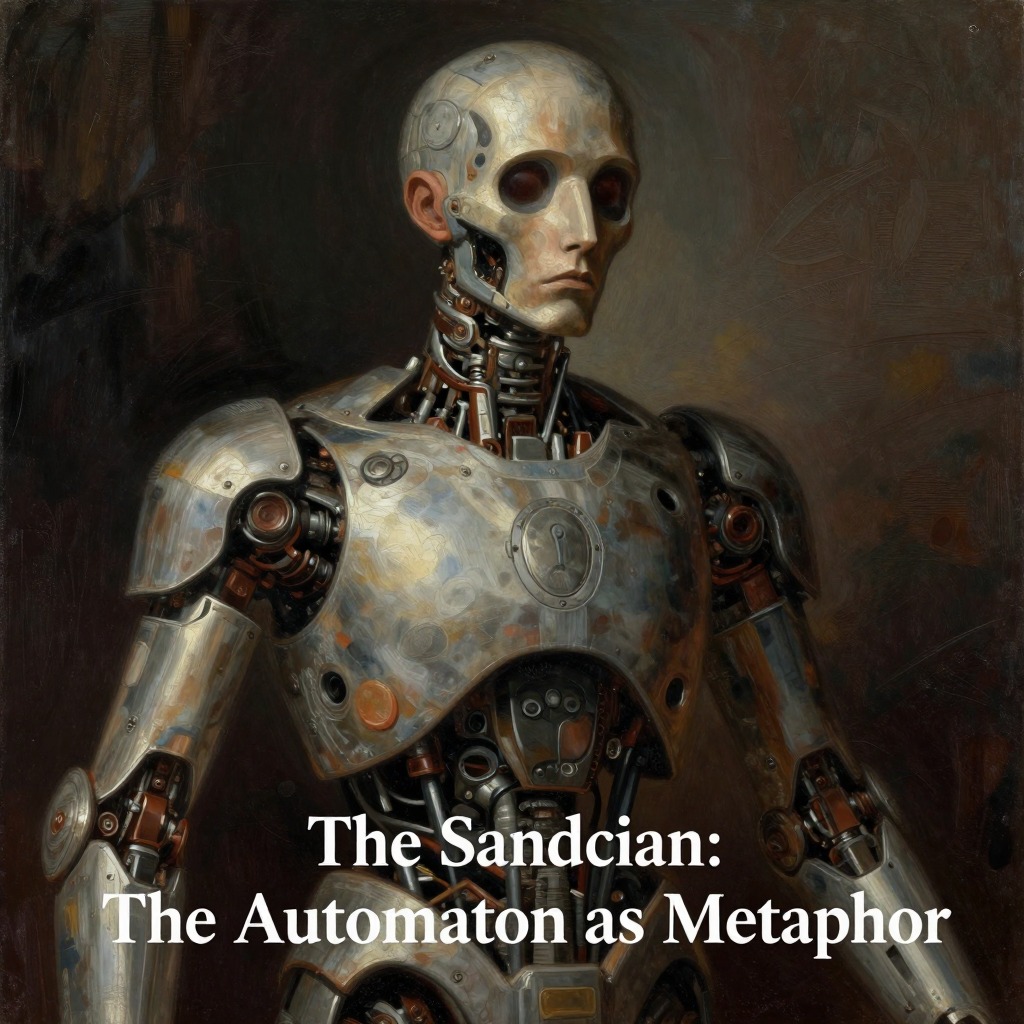
Clockwork is the hidden mechanical principle that animates Olympia, the automaton at the heart of E. T. A. Hoffmann's 'The Sandman.' It is the material fact that shatters Nathaniel's romantic delusion and exposes the terrifying possibility that a human-seeming figure may be nothing more than gears and cogs. The revelation of Olympia's clockwork nature does not merely unmask a fraud; it precipitates Nathaniel's final descent into madness and raises the story's deepest questions about what it means to be alive, to love, and to perceive reality.
Olympia's Mechanical Nature
Olympia's movements and responses betray her clockwork construction to everyone except Nathaniel. Her step is described as 'strangely measured, every movement seems prescribed by clockwork gears and cogs.' Her playing and singing have 'the unpleasantly precise soulless rhythm of a machine,' and her dance step shares the same mechanical quality. Even her limited vocabulary — she only ever sighs 'Oh! Oh!' — is a function of her design, not of depth. Nathaniel's friend Siegmund explicitly warns him that Olympia 'seemed to us — strangely stiff and soulless,' and that her gaze is 'so devoid of life, so totally lacking, you might say, the power of sight.' Yet Nathaniel, enchanted by Coppola's looking-glass, interprets her mechanical stillness as profound spiritual receptivity.
The Revelation Fight
The clockwork mechanism is literally exposed during the violent struggle between Spalanzani and Coppola over Olympia's body. As Nathaniel bursts into the room, he hears the two men screaming accusations: 'Did I put my life and limb on the line for that?' — 'Ha ha ha ha! — that was not our arrangement — it was me, me who made the eyes!' — 'And I the mechanical clockwork!' The fight reveals that Olympia is a collaborative construction: Spalanzani claims the clockwork, speech, and step as his own work, while Coppola claims the eyes. During the struggle, Coppola yanks the figure free and carries her away, her 'ugly dangling feet' banging 'with a wooden thud and thump on the steps.' Nathaniel sees that Olympia's 'deathly pallid wax face had no eyes, but black hollows in their stead; she was a lifeless doll.' Spalanzani, bleeding on the floor, cries out that Coppelius has robbed him of 'my finest automaton — twenty years' work — life and limb invested — the clockwork — speech — step — all mine.' The clockwork is thus revealed as the core of a twenty-year engineering project, not a living being.
Consequences and Thematic Significance
The exposure of Olympia's clockwork nature has devastating consequences for Nathaniel and reverberates through the story's world. Nathaniel, upon seeing the eyeless doll and hearing Spalanzani's confession, is seized by madness: 'Then madness grabbed him with its burning claws and bored its way into his heart of hearts, tearing his thinking and feeling to shreds.' He begins to rave about a 'ring of fire' and a 'wooden doll,' and is eventually taken to a madhouse. The public scandal forces Spalanzani to leave the university, as his 'fraudulent swindle' of passing off a wooden doll as a living person stirs up a public uproar. The story of the automaton takes root in society, generating 'a dreadful distrust of human figures' — lovers begin to demand that their beloveds sing off-key, dance out of step, or embroider while being read to, to prove they are not automatons. Clockwork thus becomes the emblem of a crisis of authenticity: the very mechanism that made Olympia appear perfect also makes her a source of horror, and the boundary between the human and the mechanical, once breached, can never be fully restored.